At SPS Pouches we’ve seen that the premium pet treat market has changed significantly over the last few years. What was once a fairly traditional category dominated by large manufacturers and functional packaging is increasingly being shaped by smaller ecommerce-first brands focused on premium ingredients, natural positioning and much stronger branding. As a result, the packaging being used across the sector is changing rapidly as well.
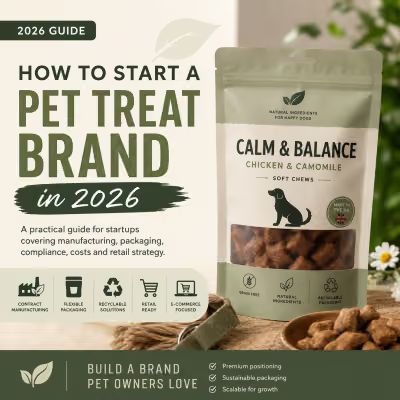
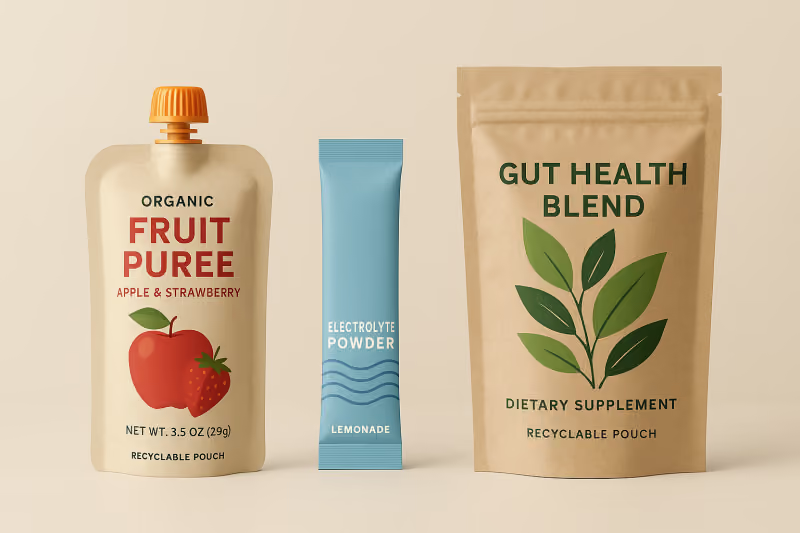
Many newer pet brands now look far closer to supplement or wellness companies than traditional pet food manufacturers. Matte finishes, softer colour palettes, minimalist branding and recyclable packaging claims have become increasingly common, particularly within natural treats, calming supplements and higher-margin functional products.
Interestingly, many premium pet brands now expect food-grade packaging standards even where regulations may not necessarily require the same specifications as human food packaging.
This is partly being driven by the wider “humanisation” of pets.
Consumers are increasingly viewing pets as family members which has fundamentally changed expectations around ingredients, branding and packaging quality. Many consumers now expect products to feel much closer to premium food or supplement brands than traditional pet food.
That shift has influenced almost every aspect of packaging design.
A few years ago, much of the pet category still relied heavily on loud FMCG-style branding with busy graphics and fairly generic packaging formats. Increasingly, brands are moving towards matte finishes, softer typography, muted colour palettes and more natural-looking packaging because consumers associate these design choices with cleaner ingredients and higher product quality.
Interestingly, transparent windows remain particularly important within pet treats. Unlike many supplement categories, consumers often want visible reassurance around the product itself. Texture, treat size and ingredient visibility all play a role in purchasing behaviour, especially within premium products where trust matters heavily.
In many ways, premium pet brands are now following the same trajectory already seen across supplements and wellness products. Consumers increasingly expect cleaner aesthetics, recyclable packaging, food-grade presentation and more natural branding rather than traditional pet food packaging conventions.
This is one reason why pouch packaging has become so dominant across the sector over the last few years.
Historically, printed pet food packaging often required large production runs, expensive gravure setup costs and significant warehousing commitments, making it difficult for smaller brands to compete visually against larger incumbents.
Digital printing and lower MOQ pouch packaging has changed that dynamic completely.
Today, many startups can launch professionally branded products without committing to costly packaging volumes, which is one of the biggest reasons why custom pouches have become so common across premium pet treats.
Importantly, this shift is not simply about aesthetics.
Packaging increasingly influences perceived product quality, ecommerce performance, retailer acceptance, fulfilment costs and long-term scalability. In practice, many modern pet startups are now being built around the flexibility that digitally printed pouch packaging allows.s
Rather than building manufacturing infrastructure themselves, many newer brands now rely heavily on contract manufacturing, outsourced fulfilment and digitally printed flexible packaging. That combination has dramatically lowered the barrier to entry for smaller businesses.
Historically, printed packaging was often one of the biggest obstacles for startups because gravure printing required large minimum orders, cylinder costs, longer lead times and significant warehouse space. As a result, many smaller brands either delayed launching or relied on generic unprinted packaging that struggled to compete visually against established retailers.
Digital printing has changed that model significantly.
Many startups can now begin with around 1,000 pouches per size while splitting artwork across multiple SKUs, allowing brands to test flavours, varying proteins and seasonal products without committing to excessive packaging stock. That level of flexibility simply did not exist for most smaller brands a few years ago.
Importantly, many founders still underestimate how much packaging economics have already changed.
Some startups initially assume printed packaging should only begin at a few hundred units, but in practice many premium pet products retail at sufficiently high price points that properly branded runs of around 1,000 units are often commercially realistic from launch.
That sounds obvious until you compare it with where the industry was not that long ago. Historically, smaller brands often had little choice but to either commit to huge packaging volumes, generally with a minimum run of 10,000pcs per SKU or launch with packaging that looked generic and struggled to compete at retail.
The reality is that modern flexible packaging has already lowered the barrier to entry dramatically.
This development is particularly important because many modern pet startups iterate quickly during their early growth phases. Branding evolves, formulations change and new flavours are introduced rapidly as brands respond to retailer feedback and ecommerce performance. Flexible packaging works particularly well within this environment because it allows startups to adapt without sitting on huge volumes of obsolete stock.
The rise of ecommerce has accelerated this further.
Flexible stand-up pouches are lighter, easier to store and considerably more fulfilment-friendly than rigid packaging formats, making them especially well suited to direct-to-consumer shipping. This is one reason flexible packaging has become so closely linked to the growth of smaller consumer brands generally, not just within pet products.
Let our team guide you through your customisation options and deliver the perfect pouch for your products.
Interestingly, many startups initially optimise packaging almost entirely for ecommerce presentation. Wider or more square-shaped pouches often photograph well online and can create stronger visual presence on Shopify stores and social content.
However, retail environments often reward very different packaging decisions.
Many startups initially focus heavily on how packaging appears online without fully considering how products will actually be merchandised in-store. In practice, independent retailers often care far more about shelf efficiency and visibility than oversized packaging formats designed primarily for Instagram presentation.
Within smaller specialist pet stores, taller and narrower stand-up pouches are frequently more commercially practical because they occupy less shelf frontage while still maintaining strong visibility. This becomes increasingly important as brands expand into independent pet retailers, farm shops and garden centres where shelf space is often more limited than traditional supermarket environments.
Retail practicality is something many startups only begin properly considering once they move beyond ecommerce.
Euroslots are another good example of this.
Many startups now include hanging capability from launch, even if products are initially ecommerce-only, simply because it gives retailers more merchandising flexibility later without requiring packaging redesigns. It is a relatively small detail, but these are often the kinds of practical decisions that make scaling into retail easier later on.
Stand up pouches also remain considerably more economical than many more complex pouch formats. While box bottom pouches can work well for larger products such as protein powders, they are often unnecessary for many dried pet treats and can increase packaging costs unnecessarily for startups.
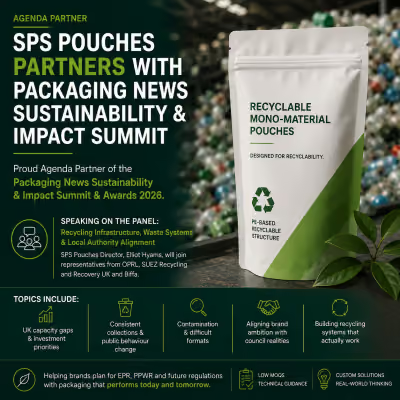
One of the biggest shifts happening across the pet food sector is the movement towards recyclable mono-material flexible packaging.
A few years ago, many pet products still relied heavily on mixed-material laminates and aluminium structures that were difficult to recycle. Increasingly, the market is moving towards recyclable mono-material packaging instead.
Importantly, most dried pet treats simply do not require aluminium foil barriers.
That means mono-material PE structures with EVOH barriers are now suitable for a large proportion of the category while still providing the barrier performance required for many products.
This is one reason recyclable flexible packaging has accelerated so quickly across premium pet treats over the last few years.
The direction of travel is becoming increasingly clear. Retailer expectations, PPWR, EPR fee modulation and future recycling infrastructure are all pushing the industry towards recyclable-ready packaging structures.
Large retailers are already heavily influencing these packaging decisions, but the same expectations are increasingly filtering into smaller specialist retail as well. For many startups entering the market today, recyclable mono-material packaging is increasingly viewed as the commercially sensible default rather than a niche sustainability feature.
This is becoming particularly important for brands looking to export into European markets as well.
PPWR is likely to reshape packaging expectations significantly across the EU over the next few years, particularly around recyclability, packaging reduction and material choices. As a result, many brands are increasingly looking for packaging suppliers that already understand recyclable mono-material structures, future compliance direction and the wider sustainability expectations emerging across European retail.
As a result of this, brands entering larger retail environments are simply expecting recyclable packaging conversations to happen from the beginning rather than later as part of a sustainability transition.
Barrier protection, seal integrity and shelf life remain critical considerations, particularly for products containing natural fats or sensitive ingredients. Sustainable packaging claims become fairly meaningless if products arrive damaged, stale or compromised, which is one reason barrier performance still matters heavily despite the industry’s wider push towards recyclability.
However, modern mono-material structures with EVOH barriers are increasingly capable of delivering sufficient protection for many dried pet treats while also aligning more closely with future recycling systems.
As kerbside film collection infrastructure expands across the UK, recyclable flexible packaging is likely to become even more common throughout the sector.
Our recent pouch recyclability study has proven that mono-PE pouches are compatible with existing UK recycling infrastructure and we expect that this will become the go-to solution for pet food brands.
In many ways, flexible packaging is no longer simply supporting the growth of modern pet brands — it is one of the main reasons many of these brands are commercially viable at all.
Perhaps the biggest shift of all is that packaging is no longer viewed simply as a means to an end.
Within the pet treats industry, packaging itself increasingly forms part of the overall product experience. Consumers now associate packaging quality directly with freshness, trustworthiness, ingredient quality and premium positioning, which is one reason professionally custom printed pouches have become so dominant for newer pet brands.
Modern pet food startups increasingly behave more like ecommerce lifestyle brands than traditional FMCG companies. Branding, fulfilment, packaging flexibility and shelf presentation all play a major role in how products scale.
Pouch packaging is no longer simply replacing older packaging formats — it is actively reshaping how modern pet brands are launched, marketed and positioned in the first place.
If you have any enquiries concerning our pouch packaging, or would simply like to get in touch with our team, you can use the contact form or details below.