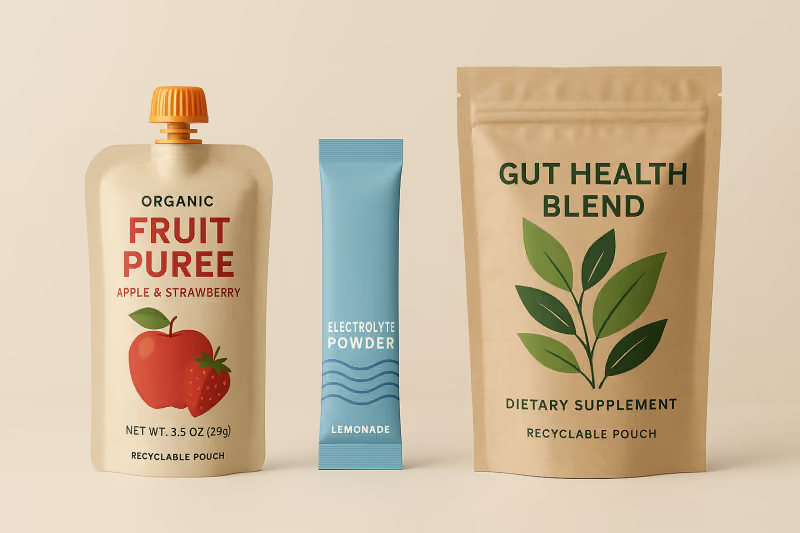
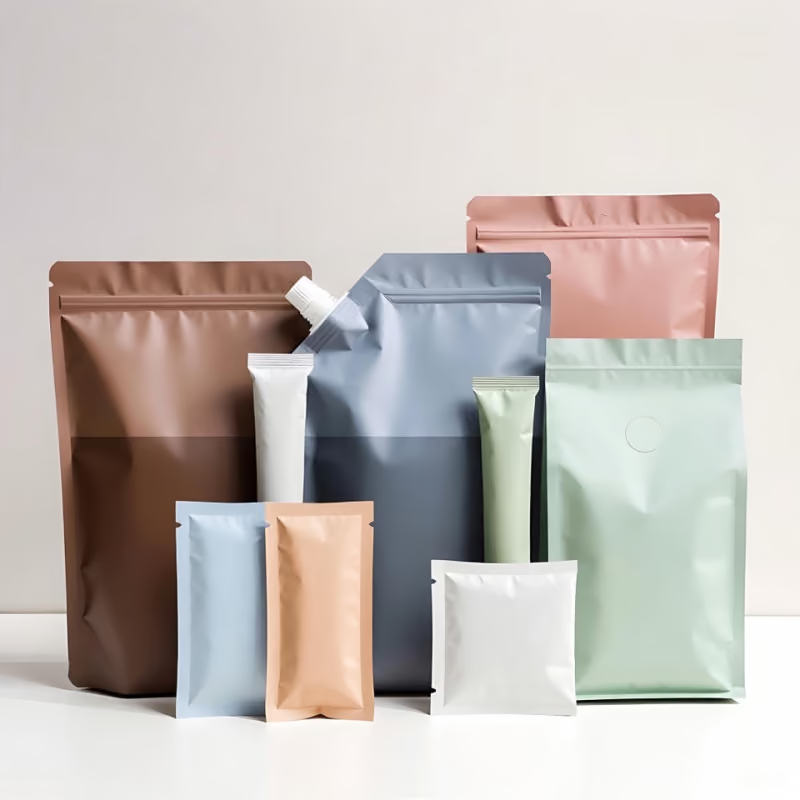
Ecommerce packaging is chaging quickly and as online retail sales have grown, small brands have had to deal with rising fulfilment costs, new sustainability rules and the practical reality of sending fragile or bulky products through increasingly complex courier networks. What used to be a simple choice between boxes and a plastic tub has become a deeper conversation about efficiency, carbon impact and commercial viability. Within that shift, flexible pouches have become one of the strongest ecommerce packaging formats for food, drink, supplements and household products. They aren’t the answer for everything, but in many categories they solve problems that rigid packaging formats simply can’t — particularly for founder-led brands trying to launch online without absorbing huge shipping and material costs.
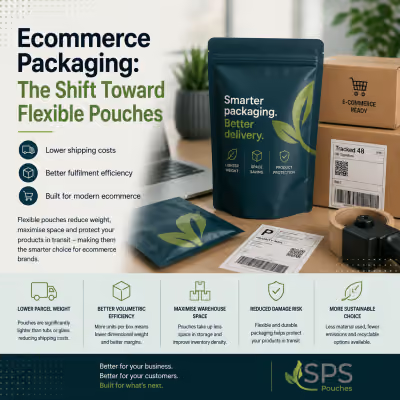
Courier pricing has fundamentally changed the packaging landscape. Royal Mail, Evri and the larger carriers now calculate cost based on volumetric weight, so anything bulky or rigid becomes expensive to move. Glass jars, tubs and rigid plastics often feel like the “proper” choice, but they occupy a lot of dead space and usually need protective packaging to stop damage in transit.
For a new brand, those few extra centimetres are the difference between a profitable order and a loss. A product that can ship as a large letter has a completely different economics compared with a small parcel — and for many categories, a stand-up pouch is the only way to achieve that.
A founder we spoke to recently — launching a hot sauce brand — had costed his options. Once he factored in glass weight, possible breakages, void fill, shippers and parcel pricing, the numbers didn’t stack up. A spout pouch gave him enough durability, cut his fulfilment costs significantly and still looked credible on the shelf. That’s increasingly how ecommerce packaging decisions are being made: not around tradition, but around the commercial realities of online retail.
Amazon in particular has reshaped how brands think about packaging. Products must meet strict dimensional and labelling criteria, and founders often underestimate how limiting this becomes with rigid formats:
“Products must meet all product packaging requirements… Products that do not comply may receive additional handling fees or be made non-fulfillable.”
— Amazon Prep Requirements
Flexible pouches give small brands two major advantages here:
Boxes and rigid packaging often need die-cut tooling or moulds if the product doesn’t fit standard sizes.
Custom printed pouches don’t.
They’re custom-made to the millimetre.
Startups can design around Amazon’s letterbox and parcel thresholds — something that is almost impossible with jars or tubs.
Rigid formats usually require additional barcode labels, which increases labour and can lead to compliance failures when labels fall off.
Pouches can have barcodes printed directly onto the laminate.
Digital printing allows multiple colourways, flavours or formulations to be printed in small MOQs — ideal for brands with variant-heavy ranges.
For ecommerce sellers, that control and flexibility removes an entire layer of admin and reduces the chances of FBA rejections.
Let our team guide you through your customisation options and deliver the perfect pouch for your products.
There is still plenty of noise around compostable packaging, but the reality for SMEs is less straightforward. Compostables are innovative, but they’re also two to five times the cost of recyclable PE and PP structures. When a brand is testing the market with 1,000 units — which is common in supplements, hot sauces, confectionery, pet treats and cosmetics — the cost gap is unsustainable.
Transport emissions also change the calculation. Across Life Cycle Assessments, lightweight flexible packaging almost always performs better than glass, tin or thick PET because it requires less energy to move. As extended producer responsibility (EPR) evolves, heavier materials are likely to attract higher fees, pushing online sellers further towards lighter, simpler structures.
This is where modern recyclable pouches come into their own: mono-PE and mono-PP laminates now offer strong barrier performance without complicated material mixes. They aren’t the fragile formats they used to be — they are engineered solutions designed for real-world use, not just sustainability headlines.
Flexible pouches increasingly win on the fundamentals:
• Lower parcel weight
• Optimised letterbox and volumetric efficiency
• Strong resistance to breakage
• Lower storage requirements for 3PL warehouses
• High branding control through digital or gravure printing
• Scalable from 1,000 units to retail-level volumes
• Effective barriers for powders, liquids and sensitive ingredients
Rigid packaging still has its place in the market, but the idea that cardboard or plastic tubs are the “default” for ecommerce is quickly disappearing.
Supplement startups have been early adopters of pouches because they live and die by their cost per dispatch. When you’re shipping protein powders, collagen, greens blends or adaptogens, every gram matters.
Pouches solve several problems at once:
• They reduce fulfilment cost
• They take up far less space in 3PLs
• They scale from micro-runs to national retail
• They allow fast artwork changes and variant launches
• They fit more easily into Amazon’s dimensional rules
Digital printing is central to this. Small brands can order multiple flavours or SKUs without investing in huge volumes. As they scale, gravure printing takes over at lower unit cost while keeping the exact same format — no change in artwork, no change in fulfilment, no disruption to customers.
This model is now also spreading across multiple product industries: hot sauces, meal replacements, powders, specialty ingredients, pet treats, DIY products, gardening, cosmetics and refill ranges.
Refill packaging has accelerated sharply in the last two years because it cuts weight, removes rigid plastic bottles and taps into consumer demand for low-waste formats.
Modern refill pouches now accommodate up to 1.5 litres using MDO-PE, BOPE and PE structures — a notable jump from the 250–500 ml limit many suppliers previously offered.
For ecommerce sellers, this matters because:
• They reduce shipping and storage weight
• They cut plastic use dramatically
• They travel safely without shatter risk
• They allow brands to ship large volume products cheaply
• They meet the direction of upcoming “green packaging” policy
Pouches can also be tailored with different spout diameters, custom spout colours, and structures suited to liquids, gels or viscous products. Combined with low MOQs (from 1,000 units), this makes refill formats accessible not just to major FMCG companies but also to smaller online brands.
Pouches continue to improve technically:
• MDO films add strength and puncture resistance
• EVOH barriers protect sensitive foods and supplements
• Matte and soft-touch finishes give a premium feel
• Digital presses now match gravure detail at short volumes
These aren’t “cheap alternatives to tubs” anymore. They’re engineered, brand-ready formats designed for real supply chains and real digital commerce.
The direction is clear:
• Shipping costs continue to rise
• EPR favours lighter, simpler, mono-material packaging
• Customers expect less waste and easier recycling
• Startups need low-MOQ, low-risk formats
• Variants and frequent reformulations require rapid printing flexibility
Traditional rigid formats struggle to deliver all of this simultaneously.
Modern pouches do.
For many online brands, ecommerce packaging is no longer about what feels familiar. It’s about what actually works — commercially, operationally and sustainably. And increasingly, the format that works best is a fully recyclable stand-up pouch.
If you have any enquiries concerning our pouch packaging, or would simply like to get in touch with our team, you can use the contact form or details below.