The mission to improve the recyclability of flexible packaging is no longer just coming from consumers and retailers, it is also coming from significant changes in policy, regulations, collection and infrastructure. Recent waste reforms mandate kerbside collections for flexible plastic packaging and local authorities will introduce kerbside collection for flexible plastic packaging by 31 March 2027 under Simpler Recycling. The sustainability credentials of pouches are often discussed in broad terms, as though the entire packaging format is either recyclable or not recyclable, good or bad. In reality, the answer is far more nuanced and material dependent. Some flexible packaging solutions are showing promising signs that they are being sorted well in existing UK recycling infrastructure, whereas others still have obvious problems that need solving. Recyclability issues can arise because of complicated use-cases such as high temperature retorting, but packaging designers are slowly realising that other aesthetic and performance features such as printing, foiling, metallisation and spouts may create challenges for recyclers. If you are a brand owner reviewing your packaging in 2026 recyclability is now a must-have, however the real consideration should be whether the pouch you choose has a credible end-of-life route in the systems that exist now, rather than the systems everyone hopes will exist in a few years’ time.
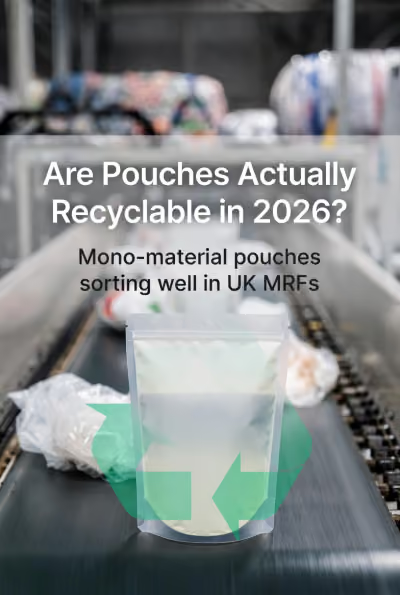
As recyclers need more consistent material streams to increase recyclate value, packaging suppliers are under increasing pressure to make pouches that are easier to identify, easier to sort and easier to reprocess in recycling plants.
To this end, the flexible packaging industry over the last few years has been moving towards mono-material design (also called ‘design for recyclability’) which means pouches should be made from one type of plastic - usually polythene (PE) or polypropylene (PP). That is why mono-pouch formats have become increasingly popular amongst pouch suppliers and are often marketed as recyclable.
Whilst mono-material solutions are not always a perfect answer in every application, the general consensus is to try and reduce material complexity, without compromising pack performance. This in turn should provide a better chance of producing packaging that fits a developing recycling system in the UK.
1.7 million tonnes of flexible plastic packaging are placed on the UK market each year, with 990,000 tonnes of this representing consumer packaging in scope of pEPR.
If more pouches are going to enter recycling systems, it becomes much more important to understand what actually happens to them and how well they perform in the existing infrastructure.
Rather than relying on unsubstantiated recyclability claims, here at SPS Pouches we partnered with RECOUP to test a range of pouch structures at a Material Recovery Facility (MRF) in Sherbourne to see how our pouch packaging performs in reality. The aim was simple: to see how our custom printed pouches behave in a modern sorting environment, how they are identified and which recycling stream they end up in.
The six structures tested were:
• MDOPE with EVOH / LDPE
• Matte OPP / VMPET / LDPE
• Matte OPP / MetOPP / CPP
• PET / Alu / LDPE
• MDOPE / BOPE / LDPE with a spout and cap
• Kraft / PET / LDPE
The strongest result came from MDOPE with EVOH / LDPE. This structure achieved 20 out of 20 positives at both sort stages and was directed into the films and flexibles stream. It was noted that this was also identified as PE by the optical sorters. That is a strong real-world indication that mono-PE pouches are performing as they should when it comes to sortability.
The Matte OPP / MetOPP / CPP pouch gave a more mixed result, with 15 positives and 5 negatives at both stages. The report says in-house NIR scans gave inconclusive results for the metallic design, and warns that if the metallic coverage were larger, the optical sorters may struggle to identify the pouch correctly and direct the pouches to residual waste. It also notes that opaque white areas on the pouch were identified as PE. In practical terms, that means heavy metallic presentation can distort how the machinery reads the pack.
That matters for brand designers as metallised effects and premium-looking finishes can help a pouch stand out on shelf, but this can clearly undermine how reliably that pouch is sorted at end of life. This was backed up by testing a fully metallic PET / Alu / LDPE structure which failed completely. It recorded 0 positives and 20 negatives at the first stage and did not progress to AI processing. The technical team concluded that this was because the highly reflective surface from minimal printed surface area caused issues for the NIR optics, making identification difficult and pushing the pouch into residual waste. That is one of the clearest conclusions in the whole trial: complete metallisation remains a serious problem for sortability.
The spouted pouch, made from MDOPE / BOPE / LDPE raised a different issue. Most samples were pushed into the 3D stream because the spout was too heavy, which changed how the pouch travelled through the plant. At Sherbourne this was not considered an immediate fail, but recycling was not guaranteed because the pack might then be removed as residue or only potentially recirculated. In other words, fitments matter and flexible packaging is not solely judged by its film structure.
Another interesting result came from the mixed laminate structure Matte OPP / VMPET / LDPE, which also achieved 20 out of 20 positives at both stages and was directed into the films and flexibles stream. That is useful because it shows the picture is not always as simple as “mono-material good, all mixed laminates bad”. Some mixed laminate structures may still sort well but the challenge is how well this transfers to high recyclate quality.
Finally, the Kraft / PET / LDPE structure was identified as paper and directed into the fibre line, but RECOUP raised concerns about the plastic lining and suggested that further discussion with paper recyclers would be needed to understand whether the plastic content would affect their process. This is worth noting because paper-based packaging is often assumed to be the safer environmental option. It may look reassuring, but appearance is not the same thing as proven end-of-life performance.
Let our team guide you through your customisation options and deliver the perfect pouch for your products.
There are a few conclusions we can draw from the Sherbourne MRF experiment.
First, mono-PE pouches perform the best in this trial and this is backed by a significant body of work conducted by CEFLEX. That does not mean every PE-based pouch is automatically “recyclable”, but it does support the wider move towards mono-material or PE-dominant structures where the packaging application allows it.
Second, foiling and heavy metallisation should be minimised where possible. Full metallisation showing failed outright, and significant metallic coverage appears capable of confusing the machinery. If you are choosing a material solely for shelf impact, it is worth understanding what that decision may mean at sortation stage of recycling.
Third, fitments can change the recycling outcome. A spout may be useful for the consumer and essential for the product, but it can also alter how the pouch behaves mechanically in the sorting system.
FlexCollect estimates just over 150,000 tonnes of flexible plastic packaging could be collected from households in 2027, rising to about 200,000 tonnes per year by 2030.
Successful sorting does not automatically mean the end result is ideal for recyclers. Some mixed structures may still be identified into the films and flexibles stream, but the downstream problem remains: what quality of recyclate does that create, and how valuable is it likely to be for end markets.
The FlexCollect report is helpful here because it says the recycling end-market trials they conducted demonstrated that flexible plastic packaging can be recycled in the UK with recovery rates typically exceeding 80%. It also states that the material is suitable for a number of mechanical recycling applications, including coloured PE flexible pellets and rigid PP applications, while some streams were suitable for plastic lumber products. At the same time, the report is clear that there is currently insufficient domestic end-market capacity to meet expected demand from 2027 onwards.
There is also the issue of economics. FlexCollect reports recycling gate fees ranging from £80 to £1,000 per tonne, with £650 per tonne the most commonly paid figure during the project. That is why homogeneous material streams matter so much. If flexible packaging is collected as a highly mixed stream, then more sorting, more upgrading and more cost sit between collection and circularity.
The long-term case for mono-PE pouch solutions is not just about making a pouch easier to describe as recyclable. It is about making the recovered material more useful and more commercially viable at end of life for recyclers.
Typical recycling recovery rates in the project exceeded 80% where suitable end markets and sorting routes e
Clearly not all pouches behave the same way in recycling streams. Foil-heavy structures remain problematic and even metallic design finishes can interfere with identification. Rigid fitments can create 2D/3D sorting problems. Mixed laminates may still be captured, but that does not necessarily make them ideal feedstock for end-users.
For brand leaders, the sensible takeaway is to think more precisely about structure, finish, fitment and the likely end-of-life route. A pouch that is designed with sorting and reprocessing in mind has a much stronger case than one that simply borrows the language of recyclability.
This experiment has shown that the flexible packaging industry is making progress and the plastic waste problem is finally being solved, but there is still plenty of work to be done.
Better outcomes will come from more careful design choices such as using mono-PE solutions and avoiding metallisation where possible.
If you are looking at custom pouches and want honest advice on which materials are likely to be the best fit for your product, shelf life requirements and wider packaging goals, get in touch with SPS Pouches. We will help you cut through the noise and find a structure that works in practice.
If you have any enquiries concerning our pouch packaging, or would simply like to get in touch with our team, you can use the contact form or details below.